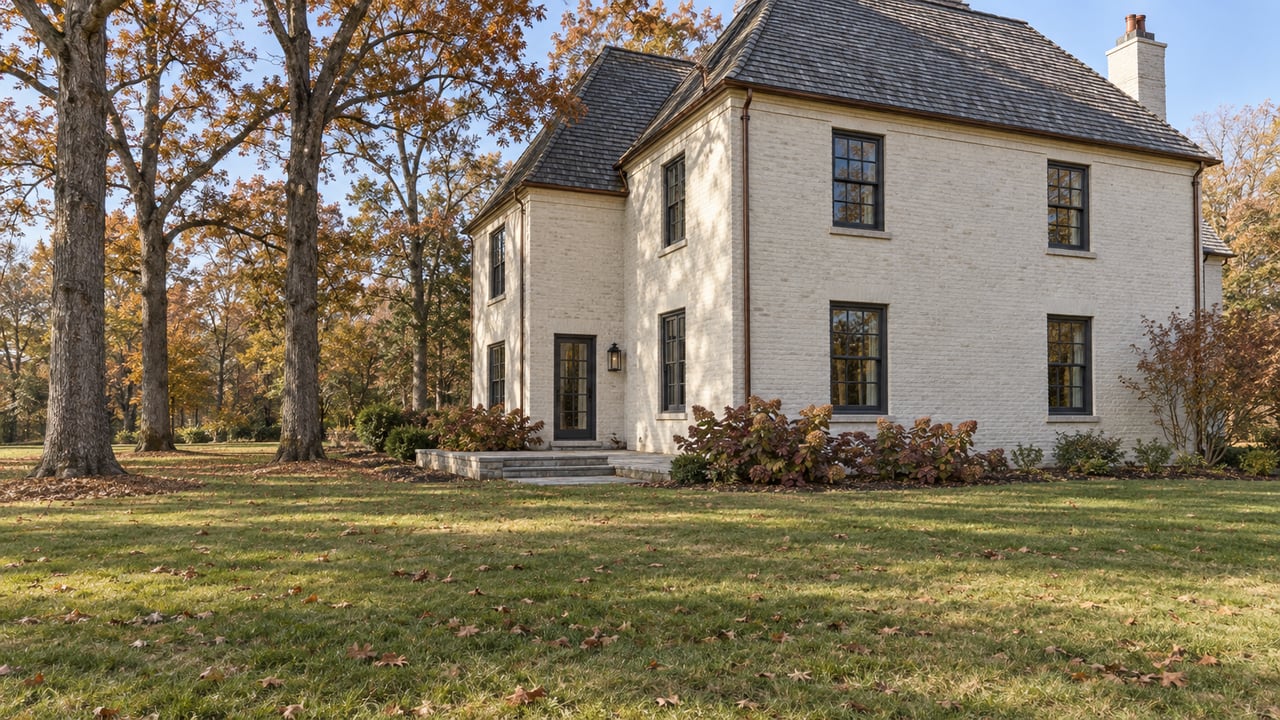
Draw a two-acre Dover parcel on paper and shade the front, side and rear setbacks. You get a band of fixed depth along the edges of the lot. Now draw a four-acre parcel in the same zoning district. The band is just as deep, but the unshaded middle is much bigger. The larger the lot, the smaller the share of it covered by that band.
The town is now reviewing its tree rules. A Tree Preservation Committee, working with the Metropolitan Area Planning Council, holds a public forum on Thursday, November 19, 2026, at Caryl Community Center, 4 Springdale Avenue. Anyone pricing a teardown, a major addition or a new build in Dover this winter is doing it while the rule is under review.
Tree protection and lot size
Dover's strongest tree protection today sits in its Stormwater Management and Erosion Control Bylaw. MAPC's July 31, 2026 working memo to the town explains that disturbing land anywhere on a lot can trigger that bylaw, "the required tree protections are only applicable to the lot setback areas."
In Dover, that rule reaches most of the land. MAPC reports that about 93% of the town, 9,251 of 9,867 acres, is zoned for one- or two-acre residential lots. Most lots are also well above their minimum size, and that is where the setback-only rule matters most.
| Zoning district | Share of Dover's land | Parcels above the minimum lot size | Median parcel size |
|---|---|---|---|
| R-2, two-acre minimum | 67.5% | About 81% | 2.77 acres |
| R-1, one-acre minimum | 31.1% | 77% | 1.08 acres |
| R, half-acre minimum | 1.2% | Not reported | Not reported |
MAPC's summary is that "a substantial portion of privately owned land remains without meaningful tree protection."
Tree protection and project costs
MAPC's summary of the existing bylaw and regulations describes:
- Trigger: land disturbance over 5,500 square feet or 25% of the lot area, whichever is smaller. A project disturbing more than 44,000 square feet counts as a major project.
- Protected tree: any tree 6 inches or more in diameter at breast height.
- Mitigation: replacement or a fund contribution, with a fee schedule of $200 to $400 per inch of trunk diameter depending on tree size.
- Replacement ratio: half an inch of new caliper for every inch of diameter removed.
- During construction: a Tree Protection Zone is required around trees that stay.
Four boards, three definitions of a tree
The setback ring is one gap. The other is that tree rules in Dover are split across several sets of regulations, and they don't agree on what counts as a tree. MAPC lists them:
- The Stormwater Bylaw protects trees 6 inches or more at breast height. The Department of Public Works enforces it on behalf of the Board of Selectmen.
- Subdivision Regulations require an inventory of trees over 8 inches in diameter, measured 4 feet above finished grade.
- Scenic Roads Regulations reach woody plants as small as 1.5 inches, measured 1 foot above ground. Trees over 4 inches must be replaced one for one, with the Planning Board approving species and location, and the Tree Warden shares oversight.
- The Wetlands Protection Bylaw, administered by the Conservation Commission, covers vegetation within 100 feet of wetlands or surface waters and 200 feet of rivers and perennial streams.
MAPC also notes the town has no incentives that reward keeping some trees to offset removing others. Dover has considered Natural Resource Protection Zoning, which allows clustered designs that preserve habitat, but it has failed to pass Town Meeting in the past.
Residents pointed at teardowns
The town ran a community survey from July 21 to September 23, 2026, and 345 people answered some or all of its questions, according to the committee's October 6 presentation. The results show which projects a future bylaw is most likely to focus on.
Among respondents who had seen significant tree removal in the past five years, new development was the most-cited cause at 37% of selections. Landscaping and site work came next at 18%, followed by house expansion at 15%. One comment in the presentation, about redevelopment on Miller Hill, read:
"literally 5 acres of mature Oak and Maple trees"
Asked which projects a bylaw should cover, respondents most often picked new residential construction (239 selections), residential subdivisions (232), and residential teardowns, major renovations and additions (208). MAPC's working materials likewise suggest the town consider additional triggers for demolition, new construction and substantial additions. Support was clear but not unanimous: 47% strongly supportive and 23% somewhat supportive. Respondents' main concerns were limits on property rights (31%), added cost (23%) and difficulty meeting requirements (22%).
The most popular exemptions show what most respondents would leave alone: dead, diseased or hazardous trees (281 selections), invasive species removal (247), septic work (228), driveway safety (173) and utility work (172). Septic work ranking third matters in a town built on large lots. The October presentation frames all of this as a "Bylaw Framework" under review, without settled thresholds. The next public step is the November 19 forum, with check-in at 6:30 p.m. and an interactive presentation at 7:00.
Dover updates its ADU bylaw
The Attorney General approved Article 18 from the May 2026 Town Meeting concerning Dover's accessory dwelling unit bylaw, according to the town's November newsletter. The approved bylaw text, Section 185-43, is public.
The two efforts meet on the same piece of ground. A detached ADU means more building footprint, more driveway and possibly more clearing, on the same large lots where the tree survey found the most concern. Meanwhile, the Housing Task Force held its final forum on October 26 with consultants Barrett Planning and Dodson and Flinker. It showed alternatives to "Dover's traditional 2-acre lots with large single-family homes," each designed around open space, ecological resources and scenic views. The resulting Housing Roadmap is on the project website. The town's Housing Production Plan expires at year-end, and its update began at a joint Board of Selectmen and Planning Board meeting on October 29.
Put together, Dover is rethinking how much house fits on its land and how much of the existing tree cover has to stay, at the same time.
Dover's housing market
Massachusetts Association of Realtors data for single-family homes in Dover shows 53 sales from January through September 2026, a median price of $2,097,900, and a median of 66 days on market. In September 2026 alone, six homes sold at a median of $1,782,500. Inventory stood at 29 homes, or 5.0 months of supply. MAR cautions that a small town's monthly figures can swing sharply on a few sales.
Buyers can walk the lot to see where the large trees stand relative to the setbacks, check for scenic road frontage or nearby wetlands, and talk with the town about plans before the price is set. For an older home on a large parcel, the location of its oaks and maples can affect what a buyer is willing to pay.
Quick Answers
Who should I contact about building an ADU in Dover? The town's newsletter directs ADU questions to Town Planner Melissa M. SantucciRozzi.
Where can I follow the tree bylaw? The Tree Preservation Committee webpage posts survey results and recordings of past meetings.
This post is general information, not legal, tax or financial advice. Please confirm how any rule applies to a specific property with the town and the appropriate professional.
If you are weighing an older Dover home on a large lot or considering a sale of your own, Emily Farrar can walk the property with you and discuss your plans. Book an appointment to start that conversation.